
Why networking gets worse as events get bigger
Networking at large conferences: what breaks, and at what size.

At fifty people, you meet everyone. At five hundred, you meet some. At five thousand, you meet whoever you happen to run into.
Same intent. Same effort. Completely different outcome.
Networking gets worse as events get bigger because the number of people you could meet grows while the hours you have to meet them stay fixed — so past a certain size, who you meet stops being a choice and becomes a function of where you were standing. The threshold is lower than most organizers assume.
The problem is not the size. It is the ratio.
Every event gives attendees roughly the same budget: a few hours of usable time, minus sessions, minus meals, minus the walk between rooms. Call it four hours of actual availability at a two-day conference.
Four hours might yield fifteen real conversations, if you are efficient and unusually good at ending them.
At a fifty-person event, fifteen conversations cover most of the room. At a five-thousand-person event, it is a rounding error — and you had no way of knowing whether those fifteen were the right fifteen.
| Attendees | Share you can realistically meet | What determines who you meet | What organizers usually do |
|---|---|---|---|
| Under 50 | Nearly all | Nothing. You meet everyone | Nothing needed |
| 50–150 | A third to a half | Seating, session choice, timing | Name tags, open mixer |
| 150–500 | Under 10% | Who you arrived with, where you sat | Add a networking hour |
| 500–2,000 | 1–3% | Physical position in the room | Add an app with a networking tab |
| 2,000+ | Well under 1% | Chance, almost entirely | Hope, mostly |
The column that matters is the third. As events scale, the deciding factor shifts from your choices to your location.
A shared badge does not fix it
Drop's founder spent several years at a company with more than 300,000 employees. There were internal events — rooms filled with nothing but colleagues. The same badge. The same employer.
And he still did not know where to start. Who is in this room? Who should I be talking to?
No answers. So he defaulted to whoever he already knew or let chance decide, and left wondering whether he had made the most of his time there.
Then came the conferences. Bigger rooms, different employers, different badges. The feeling multiplied along with the numbers.
If you feel lost in a room full of coworkers, what chance does anyone have at a five-thousand-person conference?
That is the point worth sitting with. Shared context does not solve scale. A room where everyone works for the same company or in the same industry is still unnavigable beyond a certain size. Curation is not navigation.
The same thing happens outside of work
One of our team members was at a wedding recently, with four hundred people at the reception. She did not know more than half of them and talked to about forty.
She would have liked to meet more, but you get pulled from table to table and the night passes.
All events are the same at the core. A lot is going on, only so many hours in the room, and people are missed. Every conversation that did not happen was a connection someone came for and left without.
What scale does to the economics
Consider what a room full of people is worth.
Nineteen thousand people at a sold-out basketball game, each paying a few hundred dollars for a seat, collectively represent several million dollars in willingness to be in one place. And every one of them knows exactly what they came for and where to sit.
Now picture twice that many people at a technology conference, each paying multiples of that ticket price—not for something on a stage, but to find the right investor, hire, or partner. Yet the room gives them no way to find any of them.
For the organizer, the problem runs in the other direction. You attracted two stadiums' worth of people. What actually happened between them?
The larger the event, the wider the gap between what the room was worth and what anyone can prove it produced.
Proximity without repetition
Here is the mechanism that surfaces useful connections, and why big events break it.
There was a guy at Drop's founder's gym whom he’d seen most afternoons for three months. The only thing they’d ever exchanged was a nod. Then, one week, they needed the same machine and started talking. It turned out he was an AI researcher who attended an industry event every month. Ten minutes later, he was introducing Drop’s founder to one of the organizers so Drop could be used at the event.
Three months of proximity for one lucky run-in to make it count.
Every person in a room represents an opportunity, but surfacing it usually takes repeated exposure. At gym scale, you get months to get lucky. At event scale, you get a few hours, once.
That is the compression problem at the center of large-event networking. Big events have more opportunity per room and less time per person than anything else we do.
What actually changes the outcome
Three things, in order of how much they help.
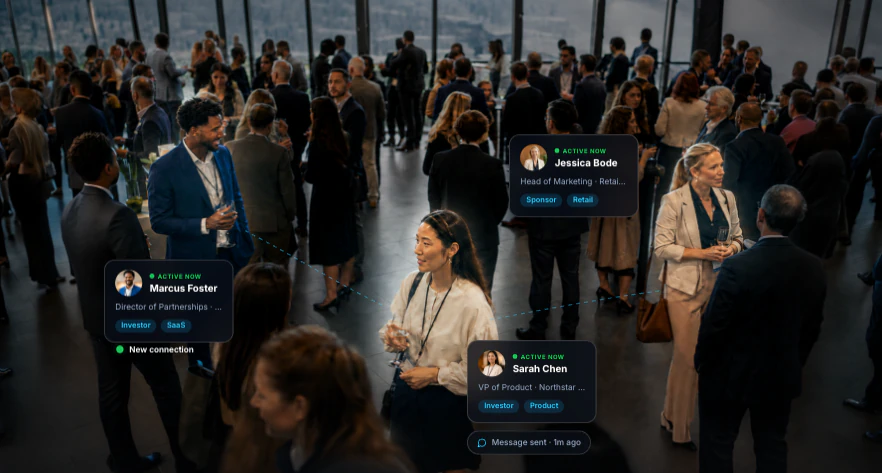
Make the room visible. If attendees can see who is present and filter for relevance, who they meet becomes a decision rather than a consequence of where they were standing. Drop Professionals is a live networking app for in-person professional events, where attendees check in and see everyone at the event, with the people nearest to them at the top of their feed.
Shorten the distance between knowing and meeting. A recommendation received three weeks before the event, about someone you cannot locate on the floor, does not convert. Relevance has to arrive while the person is reachable.
Extend the window beyond the event. The main thing large events waste is the discovery that happens too late. If connections persist afterward, an attendee who ran out of time can still find the people they missed. This is the cheapest fix for a large event and the one most often skipped.
What does not change the outcome at scale: more networking hours, bigger mixers, and asking people to "network with industry leaders" on the registration page.
The organizer's version of the question
Large events are where measurement matters most and where it is hardest. With five thousand attendees, anecdotes are statistically meaningless — you are hearing from whoever happened to tell you something.
The numbers worth collecting are outlined in how to measure networking at an in-person event. At scale, the two that matter most are participation rate, which tells you whether networking reached the whole room or only the confident part of it, and cross-segment connections, which tells you whether you built one room or several that happened to share a building.
These gaps should not exist at the sizes events now run at. To see what your floor looks like with the room made visible, request a demo.
FAQs
At what event size does networking start to break down?
Around 150 attendees, and badly past 500. Below about 50 attendees, you meet everyone without help. Between 150 and 500, you can realistically meet under 10% of the room, and above 500, physical position in the venue becomes the main factor deciding who you meet.
Does a curated attendee list solve networking at large events?
No. Curation raises the quality of the room but does nothing for navigation. A room where every attendee is relevant is still unnavigable at scale, which is why internal company events with thousands of colleagues feel just as hard as open conferences.
How do you network effectively at a very large conference?
Arrive with specific names rather than a general intent, prioritize reaching a small number of the right people over maximizing conversations, use the first ten minutes before groups form, and keep a way to reach the people you did not get to before the event ends.
Is networking better at small events?
Per attendee, usually yes, because you meet a much larger share of the room. Large events offer far more opportunity in absolute terms but give you a much smaller chance of finding any specific part of it without help.
What should organizers of large events measure about networking?
Participation rate, which shows whether networking reached the whole room, and cross-segment connections, which shows whether different attendee groups actually mixed. At large scale, individual testimonials are not representative of what happened.

Make a big room navigable.
See how attendees find the right people in a crowd of thousands — and keep them after the doors close.