
The sponsor renewal conversation, with data this time
How to prove event sponsorship ROI with networking data.
Getting a sponsor to say yes the first time isn’t the hard part—it’s getting them to say yes again.
A sponsor signs the first year on the pitch. They renew based on what actually happened. To prove sponsorship ROI, you have to hand them the outcomes their money produced — contacts exchanged, conversations started, who their team met, and when the room was most engaged — rather than the impressions you promised.
Most organizers cannot do that yet. At renewal time, what they have in their pocket is a feeling, a few nice anecdotes, a photo gallery, and attendance numbers. Meanwhile, the person deciding whether to come back is doing quiet math on whether it was worth it.
Sponsorships are still sold by the wrong measurements
Open most sponsorship prospectuses and the tiers are built on square footage, booth size, and logo placement. Gold gets a bigger banner than silver.
All of it assumes being seen is the same as being found.
Sponsors want measurements, but not these. They want to know what their money made happen. No one sponsors an event for its location; they do it for the conversations, leads, and sales that make the investment worthwhile.
The grace period on events is over
Cost per click, cost per lead, cost per breath. Every marketing dollar now needs a number behind it. Budgets that cannot show their math get cut first. The ones that can keep growing.
Event budgets never faced that reckoning. The value of being in the room seemed obvious enough, and a photo gallery with a few quotes was enough to make the case.
That is ending. The same budget conversations that forced digital marketing to get specific are now reaching events. A sponsor's marketing lead is being asked to defend the line item in the same spreadsheet as a paid search campaign that reports to four decimal places.
The events that keep growing are the ones that can show what the room actually produced.
The case study picks itself
Here is how most sponsor stories are chosen today. Whoever happens to send a nice thank-you note becomes the story you tell.
Not because it was the biggest win in the room, but because it was the one that reached you.
The real win happened somewhere across the floor you spent months building, and you never heard about it. Two people met by the coffee and six months later it was a deal, a hire, a partnership that changed someone's year. From where they are standing they credit luck and timing. They do not see the room you built. And from where you are standing, you have no idea the encounter happened at all.
That gap used to be the cost of doing this work. The value a room creates quietly disappears as attendees walk out.
The numbers a sponsor actually wants
Sponsors are buying access to people. So report on people.
| Metric | What the sponsor learns | Why it beats impressions |
|---|---|---|
| Contacts exchanged with the sponsor's team | How many attendees handed over details | A follow-up list, not an estimate |
| Profile views of sponsor staff | How many attendees looked them up | Demand for the sponsor specifically |
| Connections made by sponsor staff | Relationships their people started | The thing their sales team was sent to do |
| Attendee segments reached | Which titles, industries, and company types they met | Whether they reached their buyer or the wrong room |
| Peak engagement windows | When attendees were most active | Where to staff the booth next year |
| Share of total event connections involving the sponsor | Their slice of the room's activity | A defensible number against other sponsors' tiers |
| Post-event connections | Relationships that continued after the doors closed | Durability, which is what renewal is really about |
The last two change renewal conversations. Share of activity gives a sponsor a reason to buy up a tier. Post-event continuation proves the money bought something that outlasted the venue booking.
What a sponsor report should contain
One page per sponsor, the same format every year.
SPONSOR OUTCOME REPORT
Sponsor: ___________________   Event: ___________________   Tier: __________

REACH
Attendees who viewed your team's profiles        ______
Attendees your team connected with               ______
Contacts exchanged                               ______
Share of all event connections involving you     ______%

WHO YOU MET
Top 3 job titles              1.__________  2.__________  3.__________
Top 3 industries              1.__________  2.__________  3.__________
Target-segment connections    ______ of ______ total  (______%)

WHEN
Your peak engagement window                      ______ to ______
Event-wide peak window                           ______ to ______
   (If these do not match, your staffing missed the room)

AFTER
Connections continued post-event                 ______
Messages exchanged post-event                    ______

YEAR OVER YEAR
Contacts exchanged     this ______   last ______   change ______%
Share of connections   this ______   last ______   change ______%
Hand this over within a week of the event, while the sponsor's debrief is still happening. A report that arrives a month later arrives after the renewal decision has already begun to form.
Where the numbers come from
They come from the networking layer, not from the booth.
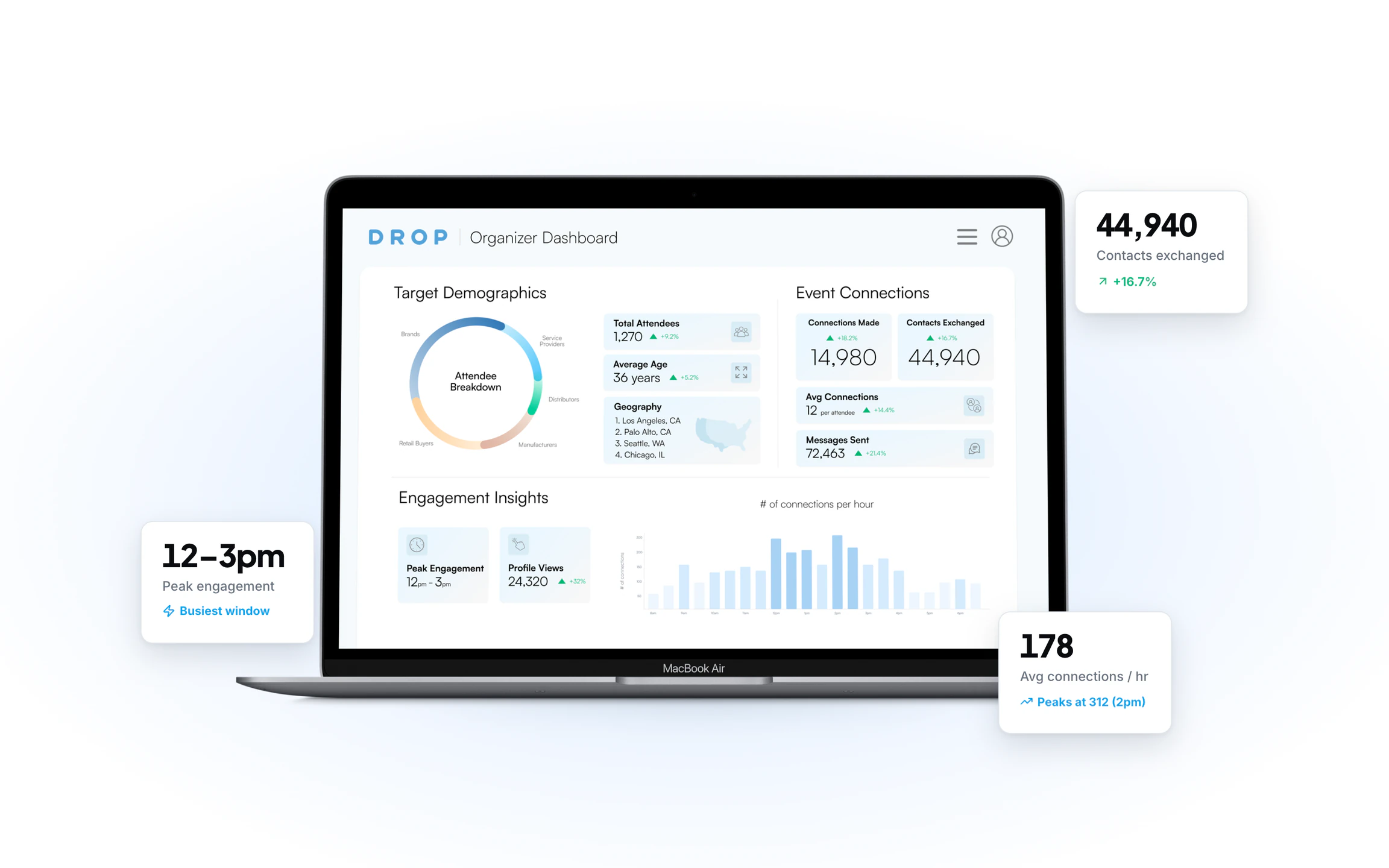
Drop Professionals is a live networking app for in-person professional events. Attendees check in and see everyone at the event, with the people nearest to them at the top of their feed. Then, organizers get a real-time dashboard of the connections, engagement, and impact their event produced — including the ones involving each sponsor's team.
That shifts the sponsorship conversation. Instead of selling space and promising exposure, you are selling access to a room and demonstrating what that access produced.
The gap worth closing is the proof, not the pitch
Most organizers spend their energy on next year's deck. The deck was never the problem. The first ticket is marketing. The second is memory.
To see what a sponsor report from your own floor would look like, request a demo.
FAQs
How do you prove event sponsorship ROI?
Report the outcomes the sponsor's money produced: contacts exchanged with their team, attendees who viewed their profiles, connections their staff made, which attendee segments they reached, and how much continued after the event. Impressions and booth traffic measure exposure; these measure contact.
What should be in a post-event sponsor report?
Reach (views, connections, contacts exchanged, share of total event activity), who they met by title and industry, their peak engagement window against the event-wide peak, post-event continuation, and the same figures from last year. One page, delivered within a week.
Why are sponsors asking for more data than they used to?
Every other marketing line item now reports hard numbers, and event budgets are held to the same standard. A sponsor's marketing lead must defend the spend in the same review as a paid campaign with per-click reporting.
Can I charge more for sponsorships if I provide this data?
Reporting outcomes gives you a defensible basis for tiered pricing, since a sponsor can see their share of the room's activity rather than the size of their banner. What you can charge depends on your event and market, but a sponsor who can measure a return has a reason to buy up rather than down.
How soon after the event should sponsors get their report?
Within a week. The sponsor's internal debrief occurs in the days immediately after, and that is when the renewal impression forms. A report arriving a month later reviews a decision already in motion.

Bring data to your next renewal.
See the sponsor outcome report your floor would produce — contacts exchanged, who they met, and when.